
• Skip to primary navigation
  • Skip to main content
  • Skip to primary sidebar
  • Skip to footer
The Institute For Alaska Native Leadership LLC

The Institute For Alaska Native Leadership

Optimizing Leadership & Governance Expertise

  • Home
  • When You Are Called to Govern
  • Guidebooks
    • The ANC Director Guidebook Series
    • The Tribal Council Guidebook Series
    • The ANC or Tribe Robert’s Rules of Order Guidebook
    • The D’Artagnan Way
  • About IADE and ITCT
    • IADE and ITCT Profiles
    • Board & Council Trusted Ally™
    • ANC CEO & Tribal Administrator Trusted Ally™
  • Enriching the Board/Tribal Council and CEO/TA Partnership
  • ANC Board and Tribal Council Advisory Services
    • Serving ANC Boards & CEOs
    • How We Advise ANC Boards of Directors
    • Serving Tribal Councils and Tribal Administrators (TAs)
    • How We Advise Tribal Councils and TAs
  • Board, CEO, Council, TA Workshops and Retreats
  • Board and Council Training Programs
  • Strategic Planning Facilitation
  • The One Page® Planning and Performance System
  • Robert’s Rules of Order Made Easy
  • Communication Tools
  • The Board Effectiveness Audit
  • Aklaq Accounting & Consulting LLC
  • Executive Recruitment
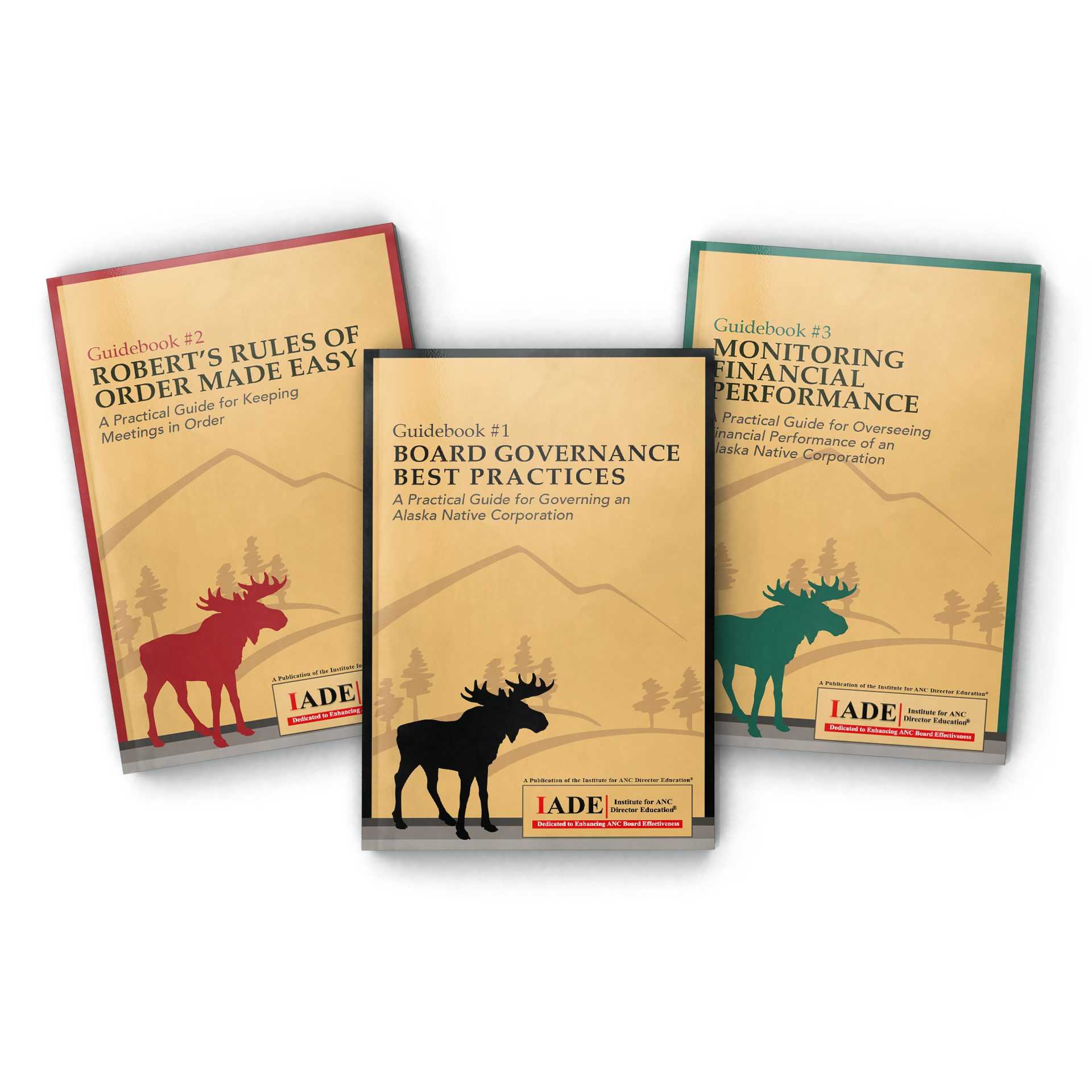
ANC Director Guidebook Series

ANC Director Guidebook Series

$149.99

For orders outside the US, please contact the author.

Three Practical Guidebooks to enhance the governance expertise and leadership effectiveness for Alaska Native Corporation directors

Category: Guidebooks
  • Description
  • Book 1 Contents
  • Book 2 Contents
  • Book 3 Contents

Description

The most effective and successful Alaska Native Corporations (ANCs) are led by directors dedicated to putting aside self-interests, shareholder, regional, village, and family politics for a greater cause – their corporation’s mission.

These guidebooks have been created to enhance the governance expertise and leadership effectiveness of ANC directors. They are written exclusively for Alaska Native Corporation directors based on Dr. Harvey A. Meier’s more than 45 years of experience in advising ANC boards in Alaska and privately-owned companies in the lower 48.

In addition to facilitating his Director Training Course, attended annually by over 100 ANC directors, he travels to villages, facilitates board trainings and shows directors how to deliver wisdom and leadership in their boardrooms.

The three guidebooks cover these topics and many more:

  • What your roles and responsibilities are as a director
  • How to use Robert’s Rules of Order to keep meetings in order
  • How to understand finances and financial statements — so you know if your money is safe and is being managed properly
  • What the responsibilities and accountabilities are of your CEO

Learn to be well prepared to effectively perform your oversight and governance responsibilities:

  • Enhance your director skills and leadership ability
  • Improve communications in the boardroom
  • Strengthen the Board & CEO partnership
  • Plan for the future

Book 1 Contents

Guidebook #1 – Board Governance Best Practices

INTRODUCTION
iv
ABOUT THIS GUIDEBOOK
vi
WHAT IS AN ALASKA NATIVE CORPORATION
viii
BOARD GOVERNANCE
1
Section 1 Qualifications and Expectations of an ANC Director
1
Section 2 Principles
2
Section 3 Board Responsibilities
4
Section 4 Board Tasks and Accountabilities
5
Section 5 Criteria for Separating Board and CEO Decisions
6
Section 6 The Board and CEO Decision-Making Boundaries
8
(a) Board Decisions Solely
8
(b) CEO Decisions Solely
9
(c) Shared Decision Areas (Board and CEO)
10
Section 7 Why Boards Succeed
10
Section 8 The Board as a Partner
11
Section 9 The CEO as a Partner
12
Section 10 Nine Questions that Matter
12
Section 11 The Board-CEO Partnership: Four Critical Questions
13
Section 12 Legal Responsibilities of Board Members
13
(a) Duty of Loyalty
14
(b) Duty of Care
14
(c) Duty of Obedience
15
(d) Duty of Confidentiality
15
Section 13 The Business Judgment Rule
15
Section 14 Director Ethical Responsibilities
17
(a) Warning Signs
18
(b) When In Doubt, Directors Should Ask
18
Section 15 Removal of a Board Member
18
Section 16 Director Indemnification
19
Section 17 Board Member Risk Management Responsibilities
20
(a) Use of Commercial Property Insurance
20
(b) Use of General Liability Insurance
20
(c) Use of Directors and Officers Liability (D & O) Insurance
21
(d) Use of Employment Practices Insurance
21
(e) Use of Crime Insurance
22
(f) Use of Fiduciary Liability Insurance
22
SPECIAL GOVERNANCE CONSIDERATIONS
23
Section 1 Board Committees and Charters
23
(a) Executive Committee
24
(b) Finance/Audit Committee
25
(c) Compensation Committee
25
(d) Strategic Planning Committee
25
Section 2 Bylaw Amendments
25
Section 3 New Director Orientation
26
Section 4 The Board Policy Manual
30
Section 5 Conflict Resolution in the Boardroom
33
Section 6 Director Communication Styles
35
Section 7 Evaluating Board Performance
38
Section 8 Evaluating CEO Performance
39
Section 9 The CEO Selection Process
41
Section 10 CEO, Senior and Support Staff Compensation
43
Section 11 The Strategic Planning Process
45
APPENDICES
A. Sample ANC Director Pledge
50
B. Sample ANC Board Code of Conduct
53

Book 2 Contents

Guidebook #2 – Robert’s Rules of Order Made Easy

INTRODUCTION
iii
ABOUT THIS GUIDEBOOK
v
WHAT IS AN ALASKA NATIVE CORPORATION
vii
ROBERT’S RULES OF ORDER
1
Section 1: Board Meeting
1
    (a) Example Board Meeting Agenda
1
    (b) Minutes of Board Meetings
2
    (c) The Executive and Closed Board Session
3
Section 2: The Annual Shareholder Meeting
5
Section 3: Shareholder Communications
6
Section 4: Using Robert’s Rules of Order (RRO) to Conduct Board and Shareholder Meetings
7
    (a) What is Parliamentary Procedure?
8
    (b) Principles of Parliamentary Procedure
8
    (c) Quorum of Members
8
    (d) Characteristics of an Ideal Chairperson
10
    (e) When is it proper for the Chairperson to Enter into
Debate/Discussion or Vote?
11
Section 5: Voting Practices for Those Eligible to Vote
11
    (a) Quorum
11
    (b) Majority
11
    (c) Abstention Votes – Do They Count?
12
Section 6: General Guidelines for Using RRO
12
    (a) Motions
12
    (b) Improper Phrases
13
    (c) Point-of-Order
13
    (d) Obtaining the Floor
14
    (e) Asking to Speak to Make a Motion
14
    (f) Speaking More than Once
14
    (g) Relevancy of Discussion
14
    (h) Decorum in Discussion
15
    (i) Conduct During Discussion
15
Section 7: The Seven Fundamental Motions Used During Board
and Shareholder Meetings
16
    a) The Steps in Making a Motion
16
    b) How to Present a Motion
16
    c) The Seven Fundamental Motions
18
        (1) To State the Motion (To Present an Item for Consideration and Action by the Board)
18
        (2) To Table the Motion (To Defer/Postpone an Action)
18
        (3) To Stop Discussion and Vote
18
        (4) To Refer the Issue/Matter to a Committee (Further
Study of the Proposal)
18
        (5) To Amend the Motion (to Modify a Motion)
19
        (6) To Amend the Amendment (to Modify an
Amendment)
19
        (7) To Adjourn the Meeting (to Close a Meeting)
19
        (8) Chart Illustrating Seven Fundamental Motions
20

Book 3 Contents

Guidebook #3 – Monitoring Financial Performance

INTRODUCTION
iii
ABOUT THIS GUIDEBOOK
v
WHAT IS AN ALASKA NATIVE CORPORATION
vii
MONITORING FINANCIAL PERFORMANCE
1
Section 1: Financial Statements
1
    (a) The Balance Sheet
1
    (b) The Income Statement
3
    (c) The Statement of Cash Flows
4
    (d) The Operating Budget
5
    (e) The Cash Flow Budget
5
Section 2: Understanding, Monitoring, and Reviewing Financial Performance
7
    (a) Reviewing the Balance Sheet
8
    (b) Reviewing the Income Statement
10
    (c) Use of a Compliance Dashboard
12
Section 3: Types of Outside, Independent Accountant Engagements
16
    (a) The Audit Engagement
16
    (b) The Review Engagement
17
    (c) The Compilation Engagement
18
    (d) The Preparation Engagement
18
Section 4: What to Expect from Your Auditor
19
Section 5: Four Types of Audit Opinions
22
    (a) The Unqualified Opinion
22
    (b) The Qualified Opinion
22
    (c) The Adverse Opinion
23
    (d) The Disclaimer of Opinion
23
Section 6: The Outside Contractor Accountant
23
Section 7: What to Expect from an Investment Portfolio Adviser
24
    (a) What is an Investment Adviser?
24
    (b) How to Choose an Investment Adviser
25
    (c) Creating Your Investment Portfolio Policy Statement
(IPPS)
31
    (d) How to Monitor Your Investment Portfolio’s Performance
32

Primary Sidebar

Hold the date for the Annual ANC Director & Alaska Native Tribal Council Member Training Course: March 23-24, 2026

Menu

  • Home
  • When You Are Called to Govern
  • Guidebooks
    • The ANC Director Guidebook Series
    • The Tribal Council Guidebook Series
    • The ANC or Tribe Robert’s Rules of Order Guidebook
    • The D’Artagnan Way
  • About IADE and ITCT
    • IADE and ITCT Profiles
    • Board & Council Trusted Ally™
    • ANC CEO & Tribal Administrator Trusted Ally™
  • Enriching the Board/Tribal Council and CEO/TA Partnership
  • ANC Board and Tribal Council Advisory Services
    • Serving ANC Boards & CEOs
    • How We Advise ANC Boards of Directors
    • Serving Tribal Councils and Tribal Administrators (TAs)
    • How We Advise Tribal Councils and TAs
  • Board, CEO, Council, TA Workshops and Retreats
  • Board and Council Training Programs
  • Strategic Planning Facilitation
  • The One Page® Planning and Performance System
  • Robert’s Rules of Order Made Easy
  • Communication Tools
  • The Board Effectiveness Audit
  • Aklaq Accounting & Consulting LLC
  • Executive Recruitment

The D’artagnan Way

Footer

Contact Us

    © 2026  The Institute For Alaska Native Leadership

    • Home
    • Contact IANL
    • Who We Are
    • Press Room
    • Privacy Policy